
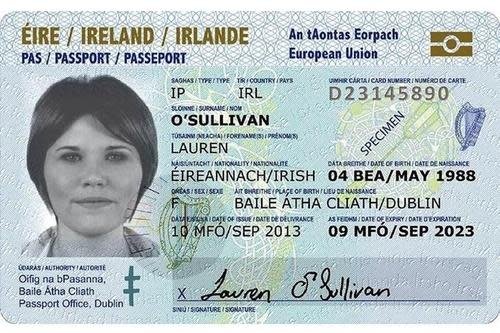
Buy an Ireland ID | Irish Passport Card for Sale
Are you in need of a real or fake Ireland ID or Irish Passport Card? Whether you require an Ireland ID for official purposes or simply as a backup form of identification, our professional team is dedicated to providing top-quality products that are virtually indistinguishable from the real thing. Our discreet and confidential ordering process ensures your privacy and peace of mind. Don’t compromise on quality or reliability – trust our expertise in delivering genuine or replica Ireland IDs and Irish Passport Cards. Buy your Ireland ID online today and experience the convenience and authenticity you deserve.
Ireland ID Card: A Comprehensive Guide
An Irish Identity Card (ID card) is a government-issued document that serves as a proof of identity for individuals who are Irish citizens or residents. However, Ireland does not currently issue a national identity card system for its citizens, unlike some other countries. Instead, Irish citizens typically use passports or driver’s licenses as identification in many situations.
Despite the lack of a national ID card for citizens, residents of Ireland from the European Union (EU) or the European Economic Area (EEA), as well as some other specific categories, may apply for an Irish Residence Permit (IRP), which functions as an identification card for non-citizens. The IRP is not the same as a standard Irish ID card, but it does serve a similar purpose for those who reside in Ireland.
Ireland’s Identity Documents
While Ireland does not have a national ID card system, there are other key identity documents available for Irish citizens and residents, including the Irish Passport and Irish Residence Permit (IRP).
1. Irish Passport
- The Irish passport is the primary form of identification for Irish citizens. It is used for international travel and serves as proof of Irish nationality and citizenship. A passport can be used as a legal identification document both in Ireland and abroad, and it also allows for visa-free travel to numerous countries.
- Eligibility: Available to Irish citizens, whether born in Ireland or abroad, and those who have acquired Irish citizenship through naturalization or descent.
- Application Process: Irish passports can be applied for online or by visiting a local passport office or embassy. The application involves submitting proof of identity, such as a birth certificate, photograph, and proof of citizenship.
2. Irish Driver’s License
- The Irish driver’s license is another widely accepted form of identification in Ireland. It is used for both driving and as a form of identity verification in everyday life.
- Eligibility: Available to residents of Ireland who are over 17 and meet the requirements to drive in the country.
- Application Process: To apply for an Irish driver’s license, individuals must pass the driver theory test, complete a driving test, and submit proof of residency and identification.
3. Irish Residence Permit (IRP)
- The Irish Residence Permit (IRP) is issued to non-EU/EEA nationals who are legally residing in Ireland. This card serves as proof of legal residence and immigration status in the country.
- Eligibility: Required for non-EU/EEA nationals who are residing in Ireland for more than three months and who hold a valid visa or have secured residency under the appropriate schemes, such as work or study permits.
- Application Process: The IRP can be obtained by registering with the Irish Naturalisation and Immigration Service (INIS) and submitting supporting documents like a passport, visa status, and proof of residence in Ireland. The card is usually issued for a period of 1-3 years depending on residency status.
Key Differences Between the Irish ID and Other Forms of Identification
While Ireland does not have a national ID card for its citizens, other documents serve as forms of identification:
- Irish Passport: Provides proof of Irish nationality and citizenship. This is the primary identification document used for international travel and as proof of identity.
- Irish Residence Permit (IRP): Only for non-citizens, this serves as proof of legal residence and immigration status. It is particularly important for those from outside the EU/EEA.
- Irish Driver’s License: Often used in day-to-day life as a proof of identity within Ireland, especially for residents and Irish citizens who do not have a passport.
How to Apply for the Irish Residence Permit (IRP)
For non-EU/EEA nationals, the Irish Residence Permit (IRP) serves as an essential identity card in Ireland. Here’s how to apply for one:
1. Eligibility
- You must be a non-EU/EEA national with legal residency in Ireland, whether through a student visa, work permit, or other residency schemes.
- You must have been living in Ireland for more than three months.
2. Required Documents
You will need to provide several important documents, including:
- Passport: Your passport, which should be valid for at least three months beyond the date of your planned stay.
- Visa or Residency Permit: Proof of your legal status in Ireland, such as a student visa, work permit, or other residence documentation.
- Proof of Address: You will need to show your current residential address in Ireland, such as a utility bill or rental agreement.
- Proof of Financial Support: Some visa categories may require proof that you can financially support yourself while residing in Ireland.
3. Application Process
- Online Application: The application for an IRP is typically completed online through the Irish Naturalisation and Immigration Service (INIS) website.
- Appointment: After submitting your application, you may need to book an appointment at the local immigration office to submit your supporting documents in person.
- Fees: There is a fee for the application, which varies depending on the length of the permit and whether it is your first application or a renewal.
4. Processing Time
- It can take between 4 to 8 weeks for your IRP to be processed, although this can vary depending on the volume of applications. Make sure to apply well in advance to avoid delays.
Benefits of the Irish Residence Permit (IRP)
- Proof of Legal Residence: The IRP is proof that you are legally residing in Ireland and helps you access essential services like healthcare and social welfare.
- Access to Public Services: If you hold an IRP, you are entitled to access services such as public health, education, and social security in Ireland.
- Travel: The IRP allows you to travel within the EU/EEA countries, but you will still need a passport or visa to enter non-EU countries.
- Work and Study: Depending on your immigration status, the IRP may allow you to work or study in Ireland without additional permits.
The Irish Passport Card
The Irish Passport Cards serves as a convenient travel document for Irish citizens, offering a compact alternative to the traditional passport book. Resembling the size of a credit card, this card is valid for travel within the European Union, the European Economic Area (comprising Iceland, Liechtenstein, and Norway), and Switzerland. While a passport may not be mandatory for entry into the United Kingdom, airlines and maritime carriers may require proof of identity during check-in. It is advisable to verify the acceptable forms of identification with your carrier before travel.
For journeys outside the EEA, your standard Irish passport book remains essential.
Irish Passport Card Applications
The Passport Service has resumed online processing for all passport types, albeit with anticipated delays. Currently, Post Offices are not accepting Passport Express applications, and in-person visits to passport offices are restricted. New passport applications can only be facilitated through the online passport service, with Passport Express services set to resume later in the season. Phone lines are now operational.
In urgent travel situations (such as family emergencies or critical medical needs abroad), contact the Passport Service via webchat.
Lost or Stolen Card
In cases of loss, theft, or damage to your passport card, furnish the requisite details within the online application form for a new card. Inform the Passport Service promptly in instances where a new card application is unnecessary due to loss or theft.
Fees and Application Process
The adult passport card is priced at €35, with an additional €5 delivery charge for applications outside Ireland, payable via debit or credit card. The adult passport bundle, encompassing a 10-year passport book and a 5-year passport card for individuals over 18, is available for €100.
For minors under 18, the child passport bundle, comprising a 5-year passport book and card, costs €45, with an extra €5 for delivery.
How to Apply
Apply for your passport card exclusively online. During the application process, ensure you have your current passport book, a compliant photograph as per dfa.ie guidelines, a valid email address, and a debit or credit card for payment.
Conclusion
Although Ireland does not have a national ID card system for its citizens, there are several forms of identity verification that serve similar purposes. The Irish passport is the primary means of identification for Irish citizens, while the Irish Residence Permit (IRP) is the essential document for non-EU/EEA nationals living in Ireland.
For residents and citizens, other identification documents, such as the Irish driver’s license, also provide reliable proof of identity in day-to-day life. If you are a non-EU/EEA national, applying for an IRP is crucial for securing legal residence and gaining access to important services and benefits.
Though Ireland does not issue a national ID card, its existing identification system is robust and provides citizens and residents with the necessary tools to prove their identity, travel internationally, and access essential services.
Be the first to review “Buy an Ireland ID | Irish Passport Card for Sale”
Related products

Buy ID Card
Buy ID Card
Buy ID Card
Buy ID Card
Buy ID Card
Reviews
There are no reviews yet.